AI for Plumbers and Heating Engineers: Practical UK Uses
Where AI genuinely helps a plumbing or heating business, from quick ChatGPT prompts to service reminders and quote chasing, and where the engineer must stay in charge.
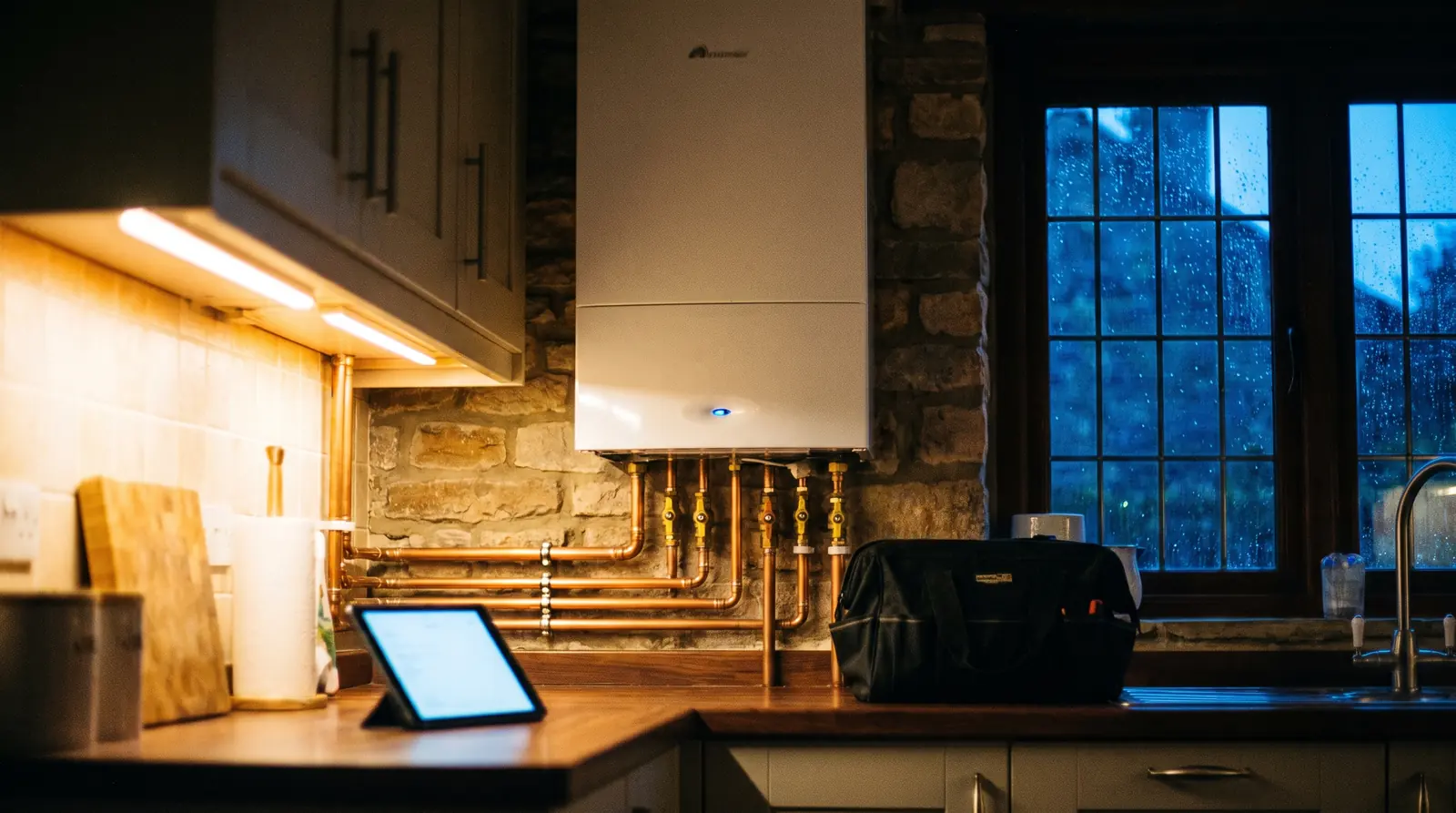
AI for plumbers in the UK is most useful in the office, not under the sink: answering missed calls, sending annual service reminders, chasing quotes and drafting the paperwork that eats your evenings. Technical judgement and anything to do with gas safety stays with you, the registered engineer. This guide covers the quick wins, the automations worth paying for, and what to leave well alone.
Where the time goes
Most plumbing and heating businesses we speak to are short of time rather than work. Powered Now's NOW Report 2026, based on research with heating, plumbing, electrical, building and renewables businesses in April and May 2026, puts the time lost to admin at 277 hours a year.
HeyBRB's UK Admin Drain Report 2026 found small business owner-operators lose an average of 8 hours a week to repetitive admin, and 77% of the trades businesses surveyed do their admin in the evenings. That is quoting, invoicing, chasing and replying to messages when you should be off.
For a typical heating firm the admin list is familiar: answering enquiries, writing quotes, booking jobs, chasing quotes and invoices, sending service reminders and filling in certificates. Most of these follow the same steps every time, which is exactly where software helps.
You would not be an early adopter either. The ONS found 29% of UK businesses used some form of AI in June 2026, with text generation the most common use at 17%.
Quick wins with ChatGPT or Claude
You can get value from a general AI assistant today for the price of a subscription. Use a business plan if you paste in customer details, and remove names and addresses the task does not need. Three prompts worth saving:
1. Turn site notes into a clear quote
'You are writing a quote for a UK heating company. Turn these notes into a clear, friendly description for a homeowner. Keep my prices exactly as written, list what is included and excluded, and do not add any work I have not mentioned. Notes: [paste notes]'
2. Explain a problem in plain English
'Rewrite this explanation for a homeowner with no technical knowledge. Keep it under 150 words and do not change the technical facts or my recommendation: [paste explanation]'. You still decide what the fault is. The AI only helps you explain it.
3. Reply to a tricky message
'A customer has sent this message about a delayed job. Draft a calm, polite reply that apologises for the delay and confirms the new date of [date]. Do not promise anything else. Message: [paste message]'
Read every output before it goes out. These tools write confidently even when they have misunderstood you.
ChatGPT for plumbers works best on writing jobs: quotes, emails, social posts and explanations you then check. It is weak at anything that depends on your diary, your price list or a customer's history, because it cannot see them unless you paste them in. That is the point where automation becomes more useful than chat.
AI for plumbers: automations worth paying for
Chat tools save minutes. Automations save hours, because they run without you. Three are worth looking at first.
Annual service reminders
Boiler services are repeat work you have already won. An automation can read service dates from your job system and send a text or email a few weeks before each one is due, with a booking link, then follow up if there is no reply. Strictly this is rules-based automation more than AI, and that is fine: it is reliable and cheap to run.
Missed calls
If you are on a job, you miss calls. A missed-call text back ('Sorry we missed you, what do you need help with?') captures details while you work. An AI receptionist goes further, answering, taking details and booking callbacks. Our AI receptionist guide covers the options and when it is not worth it.
Quote follow-up
Plenty of quotes are sent and never chased. Tradify's review of 3,271 UK trade businesses using its software (June 2025 to May 2026) found they turned 82% of quotes into jobs on average. That is a vendor figure from its own users, but the principle holds: a quote worth sending is worth a polite chase. An automation can follow up after a few days and again a week later, then flag the big ones for a phone call.
These can be combined with an AI assistant that drafts replies and updates your CRM. See our AI agents page for how that works.
What AI should not do
AI can help you type up a record or explain findings, but it must not decide whether an appliance is safe, classify a defect or tell a customer what to do in an emergency. Those decisions belong to the Gas Safe registered engineer who did the work.
- Diagnosis. AI can suggest possible causes from a description, but it cannot see the system. Treat it as a prompt for your own thinking at most.
- Regulations and instructions. AI tools can be wrong or out of date on regulations, standards and manufacturer instructions. Check the source document.
- Pricing. Let AI format a quote, not decide what to charge.
- Emergencies. Suspected gas leaks, carbon monoxide or flooding should reach a person or the right emergency line, never an AI conversation.
The APHC has written about AI in the industry, from predictive maintenance and smarter diagnostics to chatbots for customer enquiries. Those developments are real, but for most small firms the near-term gains are in the office, not the boiler cupboard.
What it costs
| Option | Cost | Best for |
|---|---|---|
| ChatGPT or Claude business plan | A monthly subscription per user (check current prices) | Quotes, emails, explanations |
| Features in your job software | Often included, sometimes an add-on | Reminders, quote and invoice chasing |
| Apex AI assessment | £495, credited in full against your first build | Working out what to automate first |
| Custom automation with Apex | From £1,000 per standard automation, 30 days support included | Service reminders, missed calls, quote follow-up |
| Ongoing support | From £97 a month, depending on scope | Keeping automations running |
| Website with built-in CRM (GoHighLevel) | From £97 a month | Firms without a CRM |
If you already use ServiceM8, Tradify or similar, check what it can do before paying for anything else. Some of what you need may be a setting you have not switched on.
The bigger cost is often your own time. A reminder sequence you build yourself in an evening is cheap if it works and expensive if it quietly stops. Whoever sets it up should check it weekly for the first month.
Worked examples from two plumbing firms
Adrian Plumbing & Heating
We built Adrian Plumbing & Heating an offline job app that handles invoices and a 142-field gas safety record, syncing with their CRM every 15 minutes. The app handles the form-filling and record-keeping. The engineer still makes every safety judgement and enters the findings. That is the right split for AI for gas engineers generally: software records, the engineer decides.
CAS Plumbing & Heating
For CAS Plumbing & Heating in Hornchurch, Essex, new Checkatrade jobs arrive in GoHighLevel within about an hour. When the team moves a lead forward, the ServiceM8 job is created with photos attached, so nobody retypes the details. It is built on n8n.
Neither build replaces an engineer. They remove the typing and copying around the work. More on our work page.
How to start without wasting money
- Write down every admin job you did last week and roughly how long each took.
- Pick the most repetitive, least risky one, usually reminders or quote chasing.
- Check whether your current software can already do it.
- If not, automate that one job properly before adding anything else.
- Measure the time saved after a month, then choose the next one.
When it is not worth it: if you are a one-person business doing a handful of jobs a week and customers are happy to ring you, a phone, a diary and a ChatGPT subscription may be all you need.
Frequently asked questions
Can ChatGPT fill in a gas safety record for me?
It can help with typing and formatting, but it must not decide the content. Readings, defect classifications and safety decisions must come from the Gas Safe registered engineer who did the work. A purpose-built job app with fixed fields is safer than a chat tool, because it records exactly what the engineer enters and does not invent anything.
Is an AI receptionist worth it for a plumber?
It depends on how many calls you miss and what they are worth. If missed calls regularly turn into lost jobs, a missed-call text back or an AI receptionist can help. If most calls come from existing customers who happily leave a voicemail, a simple text back may be enough. Look at your call log for a month before deciding.
What should a heating engineer automate first?
For most heating businesses, annual service reminders are the safest and most valuable place to start. The customers already know you, the dates are in your system, and a polite reminder with a booking link turns into booked work with very little risk. Quote follow-up is usually the next best option.
Do I need technical skills to use AI in a plumbing business?
Not for the quick wins. Anyone can use ChatGPT or Claude with prompts like the ones in this guide. Connecting systems, such as your job software, CRM and text messaging, takes more skill. That is where a done-for-you build, or an afternoon with someone technical, saves a lot of frustration.
Want to know what to automate first?
Book a free 30-minute call. We will look at how your jobs, quotes and calls flow and tell you where AI would genuinely save time.
Book my free callSources
- Powered Now, The NOW Report 2026 (fieldwork April to May 2026)
- HeyBRB, UK Admin Drain Report 2026, via Electrical Times (March 2026)
- ONS, Business insights and impact on the UK economy, 2 July 2026
- Tradify, UK trades report (data June 2025 to May 2026)
- APHC, Artificial intelligence (AI) in the plumbing and heating industry